
After extensive European travel in the summer of 1907, Jane Peterson left for Paris in 1908, where she studied with the prominent portrait artist, Jacques-Émile Blanche. Over the course of the year, she travelled to Brittany, working with Charles Cottet and returning to Paris to study at Claudio Castelucho’s art academy. The present work likely dates from her extended stay in France in which she observed both urban subjects and serene village scenes. Village Gossips, Brittany demonstrates Peterson’s skill as a colorist and keen observer of even the subtlest interactions taking place in her surroundings. Much of the the work created during her travels was exhibited upon her return to America, where she continued to foster a career as a celebrated painter.

In the summer of 1885, Seurat interrupted his work on La Grande Jatte and sojourned to Grandcamp, a small fishing port on the coast of Normandy. The present work appears to be a study for Seurat’s masterpiece produced during that summer, Grandcamp, Evening (Museum of Modern Art, New York). Through several successive panels, Seurat familiarized himself with the light of the northern shore, so unique from that of Paris. The present, spirited study of light surf on a sun-drenched coast marks a turning point in Seurat’s body of work: depicted in varied brushstrokes, this work suggests a greater freedom and spontaneity than the precise pointilist the studies he would resume for La Grande Jatte.
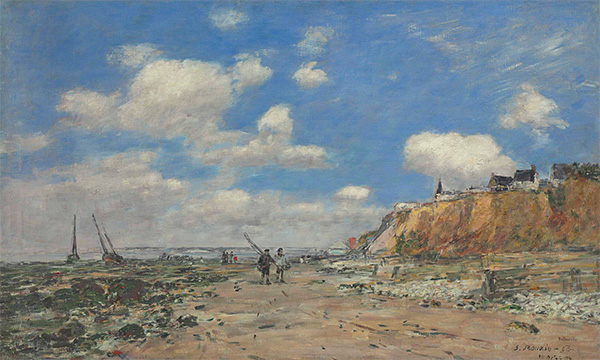
This serene landscape was painted in Villerville, a quiet commune just down the coast from Boudin’s birthplace of Honfleur. Recognized as an important forefather of Impressionism, Boudin was one of the first artists to paint en plein air. He regularly combined his masterful depictions of changing atmospheric conditions with his sharp perception of the wealthy bourgeoisie who escape to the elegant seaside resorts in the summer months, creating an innovative landscape firmly rooted in contemporary life. Boudin’s work was immensely influential and inspiring to the generations of artists which followed, particularly to a young Claude Monet.

In July 1759, the British Royal Navy under Rear-Admiral George Rodney led a two-day naval campaign in Le Havre during the Seven Years’ War. Dufy, who grew up along the coastlines of La Manche, depicts this historic event which occurred in the town in which he grew up. The artist imbued the scene with a charming warmth, the dazzling array of boats gliding along the sparkling surface of the water depicted in a boldly vibrant palette which reveals Dufy to be a consummate Fauvist.

Theodore Robinson painted the present example as part of his small 1890 series of works depicting a singular woman with two watering cans, which are considered to be among the artist's most successful canvases. “The origins of the paintings lie in a group of photographs which the artist took at Giverny of the peasant woman, Josephine Trognon…The relationship between the studies and the finished works is clearly discernable in the strong foreground shadows, the sun-dappled foliage, and the sensitive shading of the figure.” (Theodore Robinson, 1852-1896, exhibition catalogue, Baltimore, Maryland, 1973, p. 31) Other works in the series include The Watering Pots in the collection of the Brooklyn Museum, New York and At the Fountain in the collection of the Arkell Museum in Canojaharie, New York.

Lilla Cabot Perry was exposed to Claude Monet's Impressionism while training as a painter in Paris during the late 1880s, which inspired her to intermittently summer in Giverny beginning in 1889. During these Giverny sojourns, Perry and her family frequently stayed in a home neighboring that of Monet, with whom she fostered a pivotal artistic relationship. Painted in 1894, a year in which Perry was known to have spent the summer in Giverny, the present work likely depicts the artist's daughter Edith on the balcony of this home known as Le Hameau.

To find the motif for this surprisingly abstract composition, Monet did not have to venture far from home. He set up his easel on a hillside northeast of the rural Giverny’s tiny town centre, only a few minutes’ walk from the house where he lived since April 1883 with his future wife Alice Hoschedé and their combined eight children. Looking southeast over the plain of Essarts, Monet could see all the way to the distant hills around Bennecourt, some eight kilometres from Giverny and following the line of the Seine upstream. At the far left, immediately beyond the first stand of trees, are the houses and farm buildings that clustered together on land known locally as Le Pressoir (the cider press), Monet’s own home among them.

In the summer of 1906, Frieseke settled in Giverny, France, where the landscape, sunshine and freedom to paint as he wanted inspired him to remain there for almost two decades. The richly patterned interior in Morning Toilet recalls the works of Pierre Bonnard and Édouard Vuillard. Indeed, Frieseke’s style combines the decorative style of the Nabis with the Impressionist’s interest in atmosphere and light. His ability to play with light and technique and imbue his models with an air of psychological independence, makes Frieseke one of the most accomplished American Impressionist painters of the female figure.

Frederick Carl Frieseke’s depictions of women, nude and clothed, reflect his lifelong interest in the effects of light and the Impressionist technique. With its subtle sense of interior light, as well as brightly colored brushstrokes, The Yellow Room exhibits Frieseke's skill in executing striking depictions of women in interiors. He depicted the same room—the living room of his own house in Giverny—in the Museum of Fine Arts, Boston’s The Yellow Room from around 1910. Frieseke had painted the walls of his living room a lemon yellow and decorated the room with blue rugs and curtains, a color combination that he might have seen at Monet’s house.

Lying on the banks of the Seine just eleven kilometres to the northwest of Paris, the town of Argenteuil was a popular destination for recreational boaters and weekend vacationers during the summer months of the 1870s and 1880s. Caillebotte, who diligently returned to the profiles and movements of boats on the water throughout his career, was a true aficionado with a deep passion for boating. Here, he depicts his own racing yacht, the legendary Roastbeef, in the centre of the composition, under sail as the wind catches the craft at an angle and propels it through the water.

Painted a year after his move to Argenteuil, Effet de brouillard captures the deep serenity of the Normandy countryside, where many of Monet's most celebrated and influential Impressionist works were painted. It was in Argenteuil, as a landscape artist, that he could truly indulge in his passion for plein air painting. In the present rural scene, cloaked in a diaphanous veil of atmospheric light, Monet stands in the Sannois vineyards, looking across the fields towards town. The bundles of twigs and furrowed land reference man's historic, agricultural relationship to the countryside, while the smoke-spewing factory is an unmistakable reminder of the impending industrial future.

The present work is one of three from Louis Aston Knight’s triptych, The Giant Cities, New York, Paris, London, exhibited at the 1906 Paris Salon. The work earned Knight his second consecutive gold medal from the Salon, making him the first American painter to achieve this honor. Expertly depicting the flowing waters of the Seine, iconic Paris landmarks, including the Eiffel Tower, Pont Alexandre III and the Grand Palais, populate the enormous canvas. Indeed, Knight’s fascination and prowess for depicting water is clear through the subtle effects of light and shadow that he achieves on the rippling river. A scene of Parisian serenity highly acclaimed in its own time, The Giant Cities—Paris is undoubtedly a masterwork of Knight’s oeuvre.

Dated 1791, this picture is an important view of Paris, showing the recently completed Pont Louis XVI and the equestrian statue of Louis XV at the centre of the Place Royale. The Place Royale was built between 1755 and 1772 to serve as a setting for an equestrian statue of King Louis XV, which was inaugurated in 1763 by the body of the City of Paris. The monument remained in place for only nineteen years since the statue was overturned by the crowd and then demolished in 1792 to make way for the guillotine. In 1793, the square was renamed Place de la Révolution and became the scene of the executions of Louis XVI, Marie-Antoinette, Danton, Robespierre and many others.

Paris, the cultural capital of Europe during the fin-de-siecle, played an important role in the artistic life of Isaac Israels. The present lot is an excellent example of Israels’ Parisian style. The light palette and rapid treatment of the subject matter are stylistic elements that were used by the French Impressionists, who led Isaac to change his palette. The portrayed figure characterizes all the elegance and beauty of Parisian city life around the turn of the century. Israels' use of colour changed in Paris compared to the works he made in The Hague and Amsterdam. He started to prefer delicate pastels and light and transparent oil paint. His style on the other hand remained unchanged: A dynamic way of painting, with bold brushstrokes, but with delicate results. The light palette and heavy brushstrokes are a perfect example of Israels’ Parisian way of painting.

The only American artist to exhibit with the French Impressionists, Mary Cassatt moved from Pennsylvania to France in 1865, where she studied and permanently settled, apart from a trip back to her home country in 1870. Portrait of Céleste is a quintessential example of Cassatt’s lyrical portraits of women immersed in nature, a subject that resulted from her frequent sojourns to the French countryside beginning in 1889, where she rented the Château de Bachivillers, near Gisors. With the sitter gazing pensively outward, appearing lost in thought, this work illustrates Cassatt’s shift toward increasingly meditative works that reflected “the Symbolist belief that contemplation, quiet, and daydream help to access a spiritual state.” (J.A. Barter, “Mary Cassatt: Themes, Sources, and the Modern Woman,” Mary Cassatt: Modern Woman, Chicago, Illinois, 1998, p. 86)

The present work was likely painted in Grèz-sur-Loing, where Robert Vonnoh settled in the late 1880s. The artist is credited as one of the earliest painters to introduce European Impressionism to the United States. Beginning in the 1880s and throughout his career, he travelled back and forth between his hometown of Boston and France, where he studied in Paris at the Academie Julian and, in turn, taught Impressionism at home in institutions such as the Cowles School, the School of the Museum of Fine Arts, and later at the Academy of the Fine Arts in Pennsylvania. He was impressed by the work of Claude Monet, whose influence is apparent in works such as Jardin en Fleurs for its high-keyed palette and exceptional use of light.

The Château de la Robertsau, located near Strasbourg, France, was the residence of Comtesse Mélanie de Pourtalès and Comte Edmond de Pourtalès, who came to admire Walter Gay's work after acquiring one of his paintings in 1908. Later that year, the Comtesse commissioned the present work and provided a room at the château for the artist to stay in while he painted her preferred subject, the grand Louis XVI salon. A flattering depiction of the opulent space that ultimately pleased his patron, the present work demonstrates the height of Walter Gay's celebrated interiors.

Enchanted by the deep blue skies and sun-drenched climes of the south of France, Renoir purchased the estate of Les Colettes in Cagnes in 1907. This modern Arcadia, with its sonorous rhythm of daily life, groves of olive and orange trees, and expansive views would serve as an inspiration for some of the artist’s most celebrated landscapes. Settling into his new home, Renoir commissioned a specially constructed studio with windows large enough to capture the panoramic vistas and warm Mediterranean light. Taking full advantage of the rich pictorial possibilities of his new surroundings, the studio enabled the artist to paint en plein air regardless of the weather, and to capture the present verdant tapestry of rich greens, yellows, and pinks.

Picasso produced this watercolour in the summer of 1919 while vacationing with his first wife, Olga Koklova, in Saint-Raphaël on the French Riviera. The Mediterranean, to which Picasso would gravitate throughout his life, inspired a series of compositions based on the same subject: a table covered with scarcely identifiable household utensils in front of wide-open balcony doors. In reduced, abstract form Picasso deftly depicts the blue of the sky and the sea, and infuses the room with warm sunlight in which the salty breeze becomes tangible.

During their time in France, the Hassams formed a close friendship with the Blumenthal family, who lived in Villiers-le-Bel in the Oise Valley, approximately ten miles northeast of Paris. In the present painting, Hassam depicts the Blumenthal estate with particularly wonderful effects of color and atmosphere, creating an immersive experience of the impressive garden. Energized through broken brushstrokes and effective pops of color, Hassam creates a dreamy atmosphere under the shade of the flourishing, flowering trees. A contemporary critic proclaimed of his works from this period, "We should fail to do justice to the artist if we did not call attention at the same time to the delightful effects of sunlight which he skillfully manages in several garden scenes, where the soft breath of summer can almost be felt." (as quoted in W. Gerdts, Childe Hassam: Impressionist, New York, 1999, p. 172)

In 1878, plagued by financial difficulties, Monet decided to move from Argenteuil further down the Seine valley to Vétheuil, a medieval town located some sixty kilometres northwest of Paris. He and his family, along with Alice and Ernest Hoschedé and their children, shared a house on the river, and Monet would often take a small boat out to paint. He tirelessly explored this area during his three years there, depicting the ephemeral effects of various seasons and times of day. The period that Monet spent at Vétheuil represent a decisive moment in the artist’s career, in which he began to employ a nascent serial technique that laid the foundation for his most celebrated works.
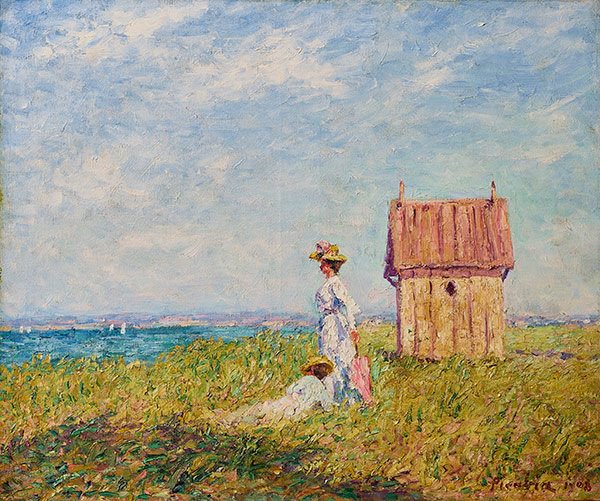
For a time heavily influenced by the works of Pissarro, Sisley, and Monet, Picabia explored the possibilities of light and atmosphere in expressing a closer affinity to nature. Resplendently capturing the atmospheric conditions of a coast near Hermanville, a small village in Normandy, Picabia reveals the influence these Impressionist painters had on his work. Unlike these predecessors, who regularly painted in plein air, Picabia often based his landscape compositions on popular printed materials such as postcards, or his own photographs and personal notebook sketches, which he would later translate into oil paintings in his studio.
